Tampilkan postingan dengan label Movie reviews. Tampilkan semua postingan

Senin, 05 Maret 2012

Okay, Matty Boy, what was your problem with the Master and Commander movie?


Hypothetical question asker! So good to have you back, it's been far too long.

The easy guess would be Russell Crowe, but honestly, I think he is just about the perfect Jack Aubrey. Brave, honest, clever as a tactician but not in the use of the English language, the movie got Jack down to a tee.

The problem was Stephen Maturin.  We see him as a physician and a naturalist, but not of him as an intelligence agent.  I understand cutting that part out, it could easily take up too much time, though I missed it dearly. The problem for me was Paul Bettany, far too tall and ten times over too pretty.


I was trying to think of better casting and the best I could come up with was David Bamber.  My favorite roles of his are as the obsequious Mr. Collins in the BBC mini-series version of Pride and Prejudice and his turn as Cicero in HBO's Rome, who stands against Caesar on principle but is not soldier enough to stand against him on the field of battle. Mr. Collins puts him in almost the right costume, and his Cicero shows him very capable of playing a beautiful wordsmith but not a beautiful man.  This haircut does an excellent job of hiding his ears, which stick out like the open doors on a 1957 Buick Special.

Of course, there is nothing like reading Patrick O'Brian, so it's just as well they made the one film to take a not particularly accurate snapshot from the twenty novel story of Aubrey and Maturin, and leave the rest of it to be enjoyed as it truly should, on the printed page.

Rabu, 05 Oktober 2011

Stuff I Like: Topsy Turvy


My favorite two musical films produced in my lifetime are O Brother Where Are Thou and Topsy Turvy. The films could hardly be more different. O Brother was the bigger box office hit, Topsy Turvy got more critical acclaim. The musical styles are in direct contrast, with O Brother celebrating the roots music both black and white of the American South, while Topsy Turvy is Gilbert and Sullivan, about as far away from roots music as you can get. Another important difference in the two movies is that every actor in Topsy Turvy who sang or played an instrument is actually performing. In O Brother, George Clooney wanted to sing his part, but he is lip-synching.

Topsy Turvy has a wonderful cast. I have not put it up to a vote, but I will venture an opinion I expect is wide held that Jim Broadbent, Shirley Henderson and Timothy Spall are always good. Allan Corduner is not quite as well known to American audiences, but he is top notch as Sir Arthur Sullivan. Martin Savage is another actor better known to British audiences than to American, and he does a wonderful job as George Grossmith, the comic actor who played Ko-Ko the Lord High Executioner in the original production of The Mikado back in 1885.


But let me turn my attention to Kevin McKidd for a moment. His first big break was in Trainspotting, the 1996 film about Scottish heroin addicts. But as is true with many a fine British actor, he can completely transform himself from role to role, and is nearly unrecognizable as the romantic tenor Durward Lely, who played Nanki-Poo. Watch this scene with him being prissy about his costume, then see some of his actual performance singing A Wand'ring Minstrel I.


Does that character remind you at all of the stern, upright and efficient Lucius Vorenus from Rome? Me, neither! I didn't realize it was the same actor until I saw Topsy Turvy again after Rome first aired.

I have the utmost respect for McKidd and wish him every success in his career going forward, though my good wishes for him are intermingled with a nearly uncontrollable jealous streak, since in his professional duties he got to snuggle and snog with Indira Varma.


In my obsessed Internet stalker brain, I believe that is my job.


Sabtu, 10 September 2011

The Debt briefly meets The Big Ugly Stick.


The Debt is a recent release that has been doing better at the box office than expected. It stars Helen Mirren and Jessica Chastain playing the same woman at different ages. Besides the cast mentioned in the ad above, there's also Ciaran Hinds in a pivotal role and it's directed by John Madden, best known for Shakespeare in Love and Her Majesty, Mrs. Brown, two very charming and funny films from the late 1990s.

This movie is torture porn. It has no charm or humor. If someone you know wants to see it and says something like "I've heard good things and I really like Helen Mirren," you should reply with "You wouldn't like watching Helen Mirren getting tortured. Matty Boy hit this movie with The Big Ugly Stick, a level of bad review he only takes out on special occasions."

For a brief rundown, the previous Big Ugly Stick movies so far are:
Never see one of these movies. Your time is too valuable. The only one that has even a few redeeming qualities is The Ghost Writer. You're welcome.


Selasa, 16 Agustus 2011

Another Earth, meet Big Ugly Stick. Big Ugly Stick, meet Another Earth.


Another Earth is a low-budget indie sci-fi flick. That might seem like a bad idea on the face of it, but I've seen some low budget movies about alternate realities or stories told in the near future that had some charm and thinking.


Another Earth is science fiction without the science. It is so depressing, you'd think it was a Communist era cartoon from behind the Iron Curtain. By comparison, Grave of the Fireflies is a light romp in the park. It gets a 61% rating on Rotten Tomatoes, which proves that at least 50% of critics cannot be trusted.


This thing is so depressing, people who see it may ask for a change in their medication. It won't help. You'll just have to get it out of your system. I saw it Saturday and I'll still bummed out Tuesday morning.


This is a movie about the decisions we make. Here's a good decision. Save yourself the time and the money. Do NOT see Another Earth. If you never see it, you will never know how much you should thank me for this.


I know in my heart I have done the right thing warning you, and that will have to suffice.


Minggu, 07 Agustus 2011

More thoughts on something Spike Lee said.

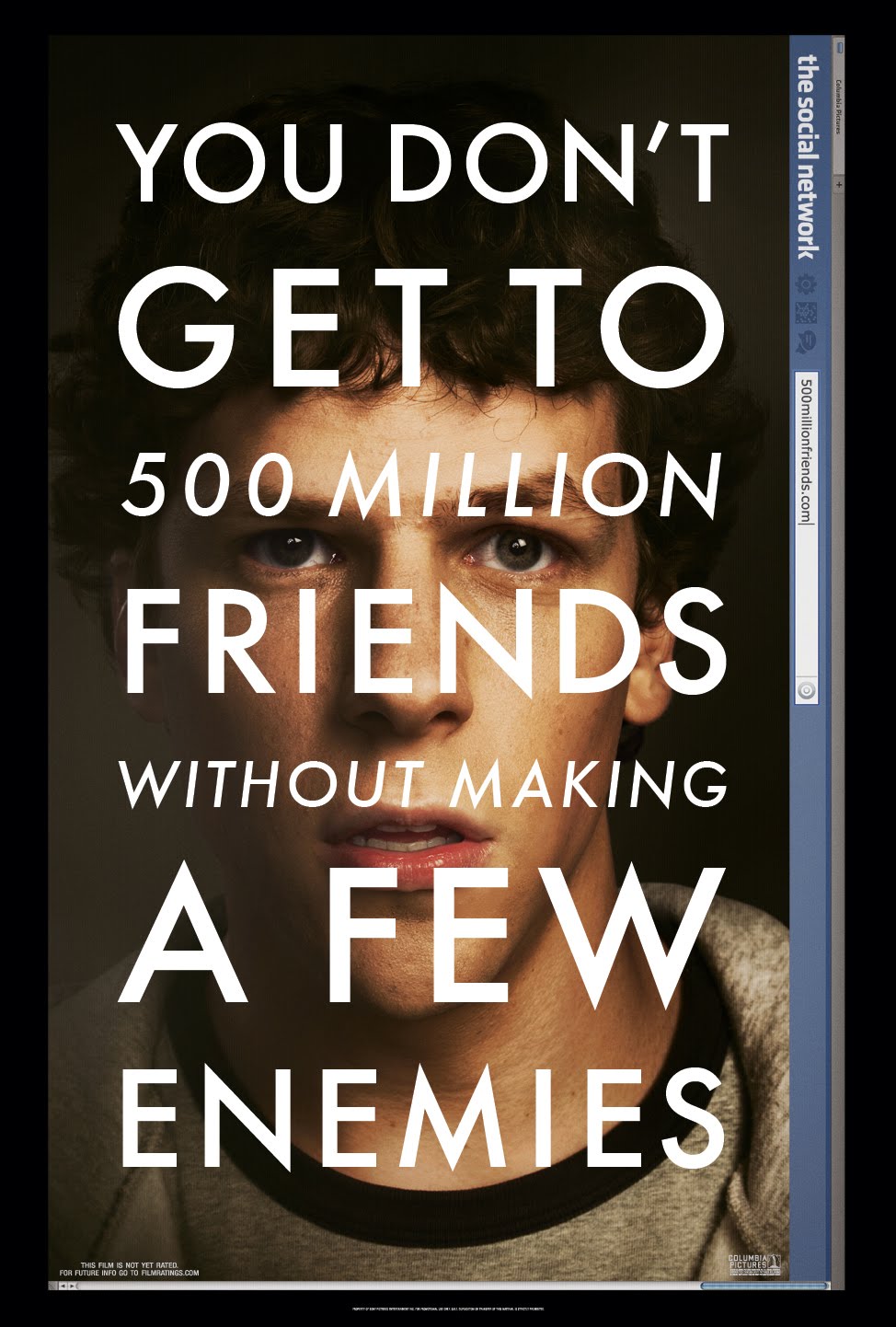
I rented The Social Network this week. I gave it a lukewarm review last year seeing it in the theater. I liked it more on second viewing. Drama should be about a character having an arc. Mark Zuckerberg (Jesse Eisenberg) doesn't have much of an arc. He starts as an asshole. He ends up as an asshole. It helps if you see him as a storm that propels the story. Other characters do have arcs, most notably the second lead character Eduardo Saverin (Andrew Garfield).


The screenplay is by Aaron Sorkin. He is best known for the quick back-and-forth dialogue style of his hit show The West Wing. Conversations are like tennis matches. The movie opens with such a conversation between Mark and Erica Albright (Rooney Mara). Mark is obsessed about status and very rude to her. She dumps him by the end of the scene. Her final line is "I don't want you to think women are not going to like you because you are a nerd. Women are not going to like you because you are an asshole."

She has a much shorter second scene in the middle of the movie. Mark sees her dining with friends in a restaurant. He goes up to her and asks if he can talk to her alone. She refuses. Both of these rejections are seen as creative fuel for Zuckerberg.


Mara's next role will be much larger. The Social Network's director David Fincher has cast her as the protagonist Lisbeth Salander in the American version of The Girl With The Dragon Tattoo. I saw the original Danish film version. People think of the book as being all arty and stuff. I thought it was a rape revenge story and the other two books were much the same. I'm not likely see the American versions.

Putting my opinions aside, there is a worldwide cult of Lisbeth Salander fans nearly as headstrong as the fans of Harry Potter or the Twilight series. The chorus of disapproval was long and loud when Ms. Mara was cast. She was too pretty. She wasn't tough enough. Lisbeth is supposed to be 4'11" and Ms. Mara has the nerve to be 5'3" in real life.

I did not hear this quibble about the 5'4" Noomi Rapace, the star of the Danish version. There may have been a similar firestorm in Europe when the first version was made. I wasn't paying attention to it. Most Americans knew nothing about her before this film, so there were no pre-conceived notions of what she was capable of doing. I'm no stranger to this feeling. Seeing a good movie with a cast unknown to me makes the willing suspension of disbelief much easier.

The title of this post mentions Spike Lee. He isn't making this movie. I brought him up because of his quote about actors which I used last month on this blog. Spike said, “You’re out there buck-naked and that is hard. (This is) the reason why actors are fucked up; can you imagine having a job where someone is, ‘No, no, no. Your butt's too big, your head's too big, you're too skinny, your nose is too big?’”

We are supposed to covet fame and fortune. The fortune part I understand. The desirability of fame eludes me.

Jumat, 05 Agustus 2011

Stuff I like: Dean Spanley


A few people, most notably my sister in law Janelle, recommended a movie called Dean Spanley, a quiet little comedy from New Zealand that played theatrically in the U.K. but went straight to DVD here in the States. Usually, "straight to DVD" means "not very good", but Dean Spanley is charming and well-acted. Sam Neill is in the title role as a British vicar who has strong memories of a previous life, and the movie also features Jeremy Northam and Peter O'Toole as an estranged son and father and Bryan Brown as a "conveyor", a middleman who is able to get his hands on Hungarian Imperial Tokay wine, an elixir that helps Dean Spanley remember his previous life more vividly.

I am intentionally not giving much of the plot away, but I give this film a very strong recommendation. Right now, I've only found it available on Netflix in streaming mode, so if you have that option, give the movie a chance. If you like sweet and eccentric comedies set in period, Dean Spanley will be a pleasant evening's entertainment, one that might bring back memories of a former life to some who watch it.

Minggu, 24 Juli 2011

The Undefeated gets beaten badly in its second week.


Let's be clear. Sarah Palin did not make the film The Undefeated. Stephen K. Bannon, a guy who has been making right wing documentaries for less than a decade with no noticeable success, wrote and directed this thing. Last week, when all the news about movies was spelled HARRY POTTER, Bannon's movie opened in ten theaters, made a respectable $65,000 and had per theater averages about the same as some other small openers, including Tabloid, a documentary by Errol Morris, who has a very good track record both commercially and critically as a documentarian (The Thin Blue Line, A Brief History of Time) and Snow Flower and the Secret Fan, a film from a popular novel directed by Wayne Wang.

Then came the second week.

Tabloid had good reviews, got into more than twice as many theaters as its first week and now stands at $283,000 in ticket sales.

Snow Flower got pounded by the critics, but it still more than doubled the number of theaters where it is being shown and has over $400,000 in ticket sales. Putting it on the list with the other two is a little bit of apples and oranges, since it was a much more expensive film to make and will be hard pressed to make back the $6 million production costs.

The Undefeated started last week in 10 theaters and jumped... to 14. The bad reviews, non-existent advertising campaign and pathetic distribution channels have had the expected effect, and after making about $65,000 in the first weekend, after ten days of ticket sales that number has climbed to a paltry $101,000. I thought it might make a million because of her name, but now it will have to pull a miracle to make $200,000.

Is the bloom finally off Sarah Palin's rose? I pray to Odin, Vishnu and the little baby Jebus it is so. We only have to convince the press that it is, because they are her last constituency. Almost everybody else has figured out she's just in it for the money and the money is drying up.

Senin, 06 Juni 2011

Bill Cunningham New York


Yesterday, I went with my adorable fashion designer niece Holly Smith-Smith to see the Richard Press documentary Bill Cunningham New York. Not being a New Yorker and knowing little about the fashion scene, I had never heard of Cunningham. He is best known now for two columns of photos that run in the New York Times. Evening Hours chronicles the mostly very well-to-do New Yorkers at charity events. On The Street features photos Cunningham gleans out hundreds of shots of passersby on the streets of New York every week, which Cunningham then edits to show some trend in the fashions being worn by everyday people.

If I were writing this review hoping to increase business for this film, this would be almost the perfectly wrong time to write it. The movie, which first opened in 2010 on the film festival circuit, has been in the theaters about three months now. It is currently playing on a total of 21 screens across the United States and has barely done $1,000,000 worth of business, a pathetic number for a regular movie but a minor success for a documentary. No date has yet been set for its release on DVD.

So I'm not writing this to tell you to see the film. When it's available for home viewing, I'll put up a post reminding my readers. I'm writing this post to say this film made we want to do something different with my life, to use what few talents I have to create more art.

Bill Cunningham is now in his eighties. As a young man in the early 1950s, after doing a stint in the Army, he became a milliner, but he gave that up. But this was not the end of his love affair with fashion. In the 1960s, he began to take photos of people who dressed distinctively, and at that time that meant the flower children and hippies. He became obsessed with taking candid photos of people out and about who caught his eye. He worked for Details magazine in the early 1980s chronicling the lesser known fashion designers before it was sold to Conde Nast. He refused to take the corporation's money, so never was seen in the magazine's pages since. He sold pictures to Women's Wear Daily of models and everyday women on the street wearing the same outfits, but quit in disgust when captions were added mocking the non-models.

Cunningham is a hermit in the biggest city in the world. He rides a bike around town, bravely sharing the road with the crazy cabbies. He wears the same utilitarian outfit every day. His jacket takes a lot of wear and tear from the camera around his neck, so he repairs it with plastic and duct tape. His apartment is filled with filing cabinets. He uses an old style Nikon camera and gets his pictures developed at a local shop called Photo King. He loves the socialites at the big charity galas every bit as much as he loves the people whose pictures he takes on the street. Several people who know him are interviewed and nearly none of them know much about his life.

Holly had seen the movie two times before and she was happy to see it again. She told me she had an old man crush on Bill Cunningham. It's easy to see why. There are a few pictures of him when he was younger, but now as an old man with a big smile filled with big teeth, he kind of reminded me of Jimmy Carter or Mr. Rogers, not only for the size of his teeth, but that all three men do what they love on their own terms. (Sadly, for Rogers that last sentence should be in the past tense, since he died in 2003.) Carter and Rogers are much more famous and greater successes in worldly ways, but Cunningham may well be the greatest artist of these three.

There are two times I have seen movies that have made we want to create art. After I saw Pulp Fiction, I went home and wrote a short story that had nothing to do with the film. After seeing Bill Cunningham New York, I've decided to buy more Penrose tiles and make some really big mosaics that I will photograph upon completion then dismantle, kind of like the sand paintings of the Tibetan monks.

I do not know how long the inspiration will last. I am not as single minded or talented as Mr. Cunningham, but I do hope to emulate his generosity of spirit in my own life in some small way.

Selasa, 17 Mei 2011

The penis: Necessary evil or evolutionary dead end?


Reading the news these past few weeks has been ultra creepy. It's nothing but penises, penises, penises.

It's not exactly like this Bay to Breakers post from sfmike, which you should DEFINITELY NOT CLICK ON AT WORK. Compared to the real news, this is almost quaint and endearing.

No, the news is filled with penises getting their users in serious trouble. You can't swing a dead cat right now without hitting a live penis, and probably an erect one at that.

I could go with a picture of Dominique Strauss-Kahn, whose penis has put him in actual jail, or Newt Gingrich or Arnold Schwarzenegger, whose penises have made them unelectable laughingstocks, but instead I go with John Ensign, who should have resigned from the Senate a year ago but waited until just recently, when he found out his penis did more than cost him a mint, it will probably mean he will be on trial and several of his Christian pals who helped engineer payoffs to clean up his penis trouble might find themselves on the wrong end of a subpoena as well.

To make matters worse, I got some movies from the library this week that in one way or another re-enforced the idea that penises are more trouble than they are worth for society. In Venus, Peter O'Toole plays an aging actor who lead a reprehensible life and is still a dirty old man.

Quite a stretch for his penis, I'm sure.

All the people who find him a cad are bad people in the film.

Then why did I find myself agreeing with them?

Having seen Thor, which is the latest film directed by Kenneth Branagh, I decided to rent Dead Again, a movie he directed and starred in with his then wife Emma Thompson before he decided Helena Bonham Carter was juicier. The movie doesn't hold up very well. It was kind of impressive at the time how good their American accents were, but since Xena:Warrior Princess, it's not such an amazing feat. There's also a scene with Campbell Scott that makes no sense, a very greasy Andy Garcia and a silly supernatural plot.

Not Ken's best work.


Last and by no means least, I watched Crimes and Misdemeanors, which I would still rank as one of Woody Allen's best. On screen, it's Martin Landau's penis that is the major cause of grief and chaos, but it's hard to ignore that Allen cast then wife Mia Farrow as the object of his character's hopeless affections. More than that, the innocent love he feels for his niece is more than a little creepy now, though none of the creepiness is in the script or the performances.

I want to say that I am not advocating the abolition of the penis. I have owned one for over fifty years and it's gotten me into very little trouble. I'm just saying that if it was an optional extra you got from a doctor instead of standard equipment, today's FDA would never approve it.

Kind of like aspirin.


Jumat, 22 April 2011

A few words (and some pictures) about objective reality.


A week ago Friday, the first film version of the 1957 Ayn Rand best-selling novel Atlas Shrugged opened in 300 theaters. The movie was made for $10 million and pulled in about $1.7 million in its first weekend.

People who love Rand allegedly love objective reality, even after all the cruel things objective reality has done to them. Here are some simple statements based on math.

$10 million is a tiny budget for a film these days and this movie is Atlas Shrugged Part 1. The filmmakers rushed the film into production because their rights were about to revert to Rand's estate, so they decided to make a trilogy and shoot the first third of the book. The second and third parts are not yet in production because they don't have the cash.

300 theaters is a very limited release and there's no way to massage these numbers into a positive thing. Sometimes a movie will get a prestige opening in Los Angeles and New York and then open wide across the country to great numbers. Clint Eastwood's Gran Torino opened in 6 theaters in December so it could be eligible for the Oscars, did land office business in those first few weeks ($45,000 per screen), then opened wide in January 2009 to be the #1 movie in America.

This will NOT be repeated by this film. Opening in 300 theaters in April is due to the movie having a weak company backing it and no stars in the cast. It averaged about $5,000 per screen, not awful per screen but definitely not special, and given there were only 300 screens, the net result is awful. The movie has to make six times its opening weekend numbers to make the initial investment back. That's not easy.

The producer postulated this week that is would be in 1,000 theaters this weekend, which is still a puny number compared to major film which open is 3,000 to 4,000 theaters. The weekend theater counts came out yesterday. Atlas Shrugged Part 1 (and probably part Omega as well) will be in 465 theaters.

Unless a right wing fatcat comes in and buys multiple boatloads of the DVD and gives them away, this turd is following a well understood pattern known as the downward spiral.

Enthusiasts of Rand are happy to tell you that Atlas Shrugged is still the #4 book on Amazon, and over the past fifty years has been second in popularity only to the Bible.

By the same argument, we can say that the New York Mets are the second best baseball team in New York over the past fifty years. Sometimes second place is a distant second place.


Cruel people on left wing websites are comparing Atlas Shrugged to another popular 20th Century book turned into a film by its zealous fans, Battlefield Earth.

This comparison is unfair. Battlefield Earth was one of the worst reviewed films of all time, but it did sell $20 million worth of tickets in 2000 in the U.S. and about $30 million worldwide. The newer movie would love to have those numbers.

Of course, Battlefield Earth was made for about $80 million, so it was a financial turkey as well as a critical disaster. So far, Atlas Shrugged has been panned by reviewers (2 good reviews out of the first 29 for 6%) and loved by audiences (85% favorable), but these are small audiences filled with cult members.

Still, making a profit on that $10 million investment is looking harder and harder, because the split on ticket sales starts in the producers' favor on opening weekend and slowly shifts in the favor of the theater owners.


Since I brought up two movies based on books revered by two 20th Century cults, let's talk about a self-financed, low budget film based on the favorite book of a First Century Mediterranean resurrection cult.

I am of course talking about Mel Gibson's Passion of the Christ.

If we are talking numbers, this is clearly one of the great success stories in movie history. 15th on the all time list, 26th when adjusted for inflation, supporters of the First Century Mediterranean resurrection cult went to the theaters in droves to support this film in 2004.

But since then... crickets.

When I googled TV listings for Passion of the Christ, I got zilch. when I wrote that nobody shows it, my dear friend and fellow nerd Abu Scooter sent me an e-mail saying it is being shown on TV by the third rate Trinity Broadcasting Network, the dessicated corpse of what Jim and Tammy Faye Bakker left behind.

This is why I love nerds. We really are deep into a cult of information. Either get it right or shut the fuck up. We are honest not because God commands us, but because when we are wrong and someone else is right, we know we lose in our hearts and no god has to tell us that.

Given that it is shown such pathetically lowly status even on cable, it is fair to say Passion of the Christ not a beloved holiday classic. It may be that now Mel Gibson is thought of as a stupid, violent middle aged racist who follows his prick around all day and beats up women when they disobey his prick, not as many of the cultists are thinking his movie was a wonderful uplifting experience, but instead seeing it for what it is, torture porn.

Because it is torture porn, it's not going to do well on commercial TV. It's hard to sell auto insurance on a new cell provider right after a scene where a guy is flayed to within an inch of his life.

Trinity Broadcasting Network shows it. Do you know the channel number of TBN on your cable box? I didn't think so.

So if you want to make a lot of money with a movie that will be attended by members of a fanatical cult, here are some handy rules of thumb.

Jesus cult, you've got a chance.

Ayn Rand cult, L. Ron Hubbard cult... save your money.

J.K. Rowling cult, J.R.R. Tolkien cult... money in the bank.

And, oh yeah. They might have made money if somebody sang and cashed in on a short-lived 21st Century cult. If Ayn Rand met Hannah Montana or L. Ron Hubbard was sung by Justin Bieber, you might be able to make a dollar on that.

Selasa, 22 Maret 2011

A few kind words for narration.

I've read several writers complain about narration in film. The big idea being violated is "Don't say it, show it." Exposition, narration's sneaky second cousin, gets bad mouthed in the same way. If you are the kind of person who watches commentary tracks, you will have heard writers apologizing to actors for any scene in which the actor is forced to give exposition. It's clunky, it slows down the pace, etc. I've never taken a screenwriting class, but I get the feeling people teaching screenwriting hate narration with a white hot hate.

As a person who watches movies but has never made one, let me say a few kind words about narration.


The documentary exclusion: Some of my favorite films are documentaries. Occasionally, a documentary can get away with no narration, like Koyaanisqatsi and Winged Migration, but these are a tiny minority of exceptions to the rule.

The vast majority of documentaries need narration and exposition. This does not make them bad films.


The opening scene narration exclusion: Some really good movies start with a scene of narration. In Citizen Kane, we get a newsreel talking about the life and death of Charles Foster Kane just before some newspaperman is sent on assignment to get more of the story. In L.A. Confidential, it's Danny DeVito reading while he is typing a story for his scandal mag Hush-Hush.

Both of these are really good movies. If you aren't convinced with those two on the list, let me throw in Casablanca, which doesn't even have a clever tie-in reason for the narration.

Sometimes it's the quickest way to set up a story. Nothing wrong with moving the action along.


One of the greatest narrated films of all time: I've already said how much I like Billy Wilder's Double Indemnity, but it bears repeating. Some think of it as the first film noir, though I think The Maltese Falcon should be put in the genre as well. Whether it's the first or not, it's one of the best. The movie has a good gimmick for the narration, as it is supposed to be Fred MacMurray confessing his crime into a dictating machine for his colleague Edward G. Robinson to find in the morning. As I pointed out in my first review, it has the line that nicely sums up the entire genre: "I did it for the money. I did it for a woman. I didn't get the money and I didn't get the woman."


A very good modern film with narration: I recently rented The Assassination of Jesse James by the Coward Robert Ford, starring Brad Pitt as Jesse and Casey Affleck as a member of the last gang assembled by the James brothers (Sam Shepard plays the much older Frank) who kills Jesse because he fears for his life. It has a great cast - Garret Dillahunt, Jeremy Renner, Sam Rockwell, Paul Schneider, Mary Louise Parker - and off-screen narration by Hugh Ross. As for the rule of "Don't say it, show it", this movie shows plenty, with a lot of long close-ups of Pitt, Affleck and Rockwell, who plays Robert Ford's brother Charley, but there's a lot of back story, and the audience wouldn't know it except for the narration.


An under-rated classic with narration: The St. Valentine's Day Massacre from 1967 is not true to the facts of the historical record, but it is a hell of a lot of fun to watch. Netflix doesn't think it's worth having around, but you can get it on Amazon.com for a reasonable price. It's directed by Roger Corman and, like all his films, made inexpensively, but it's got a great sixties cast of character actors and narration by one of the best voice actors of all time, Paul Frees. I can't say for sure, but I think Corman may have gone with voice-over narration because people were so used to it from The Untouchables, which was made in the 1960s and was also about the Prohibition era.

The reviews on Amazon are generally good, though they quibble about how little Jason Robards looks like Al Capone and how many details are not historically accurate. I am a little sorry to hear how fast and loose with the facts the movie is, because when Frees in narration says a line like "At 7:30 a.m. on the last day of his life, Albert Weinshank was having an argument with his wife about money." I want to believe it is completely accurate.

As I said, I haven't been able to find this movie on Netflix or at the Oakland Public Library, but even though it's been several years since I've seen it, I can recommend Corman's The St. Valentine's Day Massacre, not in spite of the narration by Paul Frees but because of it.


Sabtu, 19 Maret 2011

The parable of the blind men and the elephant.


I didn't intend to make a study of the reports of the causes of the financial meltdown. It happened incrementally, with some very intentional steps and others less so.

First and most intentionally, I bought and read Michael Lewis' The Big Short, which I reviewed earlier this month. Next, I rented Charles Ferguson's Inside Job based on several people's recommendations and a sense of duty to watch a few of the Oscar winning and nominated documentaries.

There are major differences between The Big Short and Inside Job. First and most obvious, it's a book versus a movie. It's easier for Lewis in his book to spend more time explaining some tricky ideas. The two of the main weapons of mass destriction, the Credit Default Swap (CDS) and Collateralized Debt Obligation (CDO), definitely qualify as tricky ideas, intentionally designed by mathematicians and lawyers to be very hard to understand.

Alliances of mathematicians and lawyers. Even I shudder at the thought, and I'm supposed to understand half of that pretty well.

The second big difference between The Big Short and Inside Job is worm's eye vs. bird's eye. Lewis talked mainly to small players who figured out how to make a profit but had zero power to stop the avalanche. Ferguson got some interviews with the big fish, though there are a lot of times the caption "xxx refused to be interviewed for this film" appears. Glenn Hubbard (no relation), the genius who engineered the Bush tax cuts, is cheerful through most of the questions until he is asked to take some responsibility for the carnage, and there is some talking head from the Business Roundtable, a pleasant sounding name for an evil lobbying group created by the ass covering buffoons who got us into this mess. Almost all of the people who sit in front of the camera and tell the truth are not Americans, people from the governments of Iceland and Singapore and France who got taken for a nasty ride and admit their foolishness and a little of their culpability but make compelling cases that they were among the fleeced and not among the fleecers.

I recommend both the book and the film, so I don't want to give all the juicy bits away. There are parts of the colossal mess that are covered by both. A very fair question is "Where were the regulators?", and both The Big Short and Inside Job have plenty of scorn to heap upon Moody's, Fitch and S&P. One thing both the movie and book agree upon is that it was in the financial interests of the rating agencies to give high marks to repackaged crap. A company would pay a set price to Moody's to rate a CDO, but if it wasn't the highest rating available, maybe that company would ask S&P to rate the next one.

The book goes into more detail than the film on this topic, as was the case regularly when they overlapped. Since the end of the Cold War, a lot of young people good at applied math would go into financial engineering rather than weapons engineering because that was obviously where the money was. Lewis puts forward the thesis in The Big Short that if a young person was going into the field for a big payday (and why else?), then the really good financial engineers (known as quants) would be at the companies giving million dollar bonuses and the second string would be at the ratings agencies who would pay mere hundreds of thousands in salary.

To use a March Madness analogy, it was like a Number 1 seed vs. a Number 16. There was effectively no chance the big money would lose.

To give a point to the film, an excellent point was made in Inside Job as to why the massive financial bailout was voted through in the fall of 2008 by both Republicans and Democrats, an event that was the last nail in McCain's grotesquely mismanaged campaign, doomed to lose six weeks before a vote was cast.

Simply put, the world runs on credit. Sadly then and frighteningly still true today, it's way too much credit, with the big financial players massively over-leveraged, sometimes in the range of 30 to 1 or even 40 to 1 when measuring obligations in the markets compared to cash on hand. While this was a zero-sum game, which means if Company X loses $50 billion, somebody else makes $50 billion, several of these companies were on the hook for more money than they had, so Company X could lose everything, say $30 billion, and others would have $20 billion less than they expected. While all of these were flat out gambling losses, it meant that the people who lent to legitimate businesses had no money to lend. The scary and completely plausible scenario was that airlines would cease to function, because they are constantly borrowing to buy that day's fuel allotment.

No financial service industry, no planes in the air.

Anywhere.

Like... oh, nowish.

No James Bond villain ever made a better blackmail threat.


Add to this mix a talk I heard on the broadcast from The Commonwealth Club by Phil Angelides, the former California state treasurer and failed Democratic nominee for the governorship who was appointed to the blue ribbon government panel investigating the financial meltdown. This was the least intentional step in my search for knowledge, as I was driving down to Santa Cruz and the broadcast came on the radio in my dad's truck.

Yes, my father is a Republican who listens to NPR. I may have to report him to the proper authorities.

The panel was set up after the 2008 elections where the Republicans deservedly got their heads handed to them, so the Dems got six members and the Republicans four. Angelides plays the good boss in this talk, lauding his staff for long hours and excellent work, several of whom are in the audience and mentioned by name. But he doesn't deny the obvious, that this was an investigation done on the cheap by government standards, spending less than $10 million before issuing their report. This is a tiny fraction of the money Ken Starr spent looking for presidential blowjobs, and that total has to be adjusted for inflation. To compare it to another financial investigation from this era, the man charged with looking into the wrongdoing of Bernie Madoff has already spent $200 million.

Charles Ferguson was in the audience at the Commonwealth Club after giving a talk earlier in the week on the same subject, and he was one of many who sent in questions as to why the government hasn't seen fit to prosecute anyone involved in the fiasco. Angelides correctly points out that it wasn't his commission's task to put people in jail, and notes that after the most recent though much smaller similar meltdown, the S&L crisis of the late 1980s, over 1,000 people were sent to jail, including CEOs. As of this writing, there has not been a single person convicted for any wrongdoing. I don't even know of any big wig who has been indicted.

Instead of chiding the judicial system, let me pick up a few sturdy bricks and throw them at the Republican nominees to this committee. Before the final panel released their report, three of the Republican nominees got together to write a rebuttal and the fourth wrote his own separate rebuttal.

Their conclusions were as predictable as the dawn. It was not the fault of their paymasters, the American corporations. It was the crazy Asian investors who had so much cash. It was the semi-government agencies like Freddie Mac and Fannie Mae. No more regulation is needed. No one is criminally culpable.

I'm not sure if it's actually detectable in my writing, but I'm trying to cut down on the addictive drug of vitriol. I actually understand and agree with some of the underlying points of conservatism, but there is really no one in power making those points. The modern "conservative" movement is a loose coalition of fucking morons who think the world is 6,000 years old and fucking thieves who think a CEO making 6,000 times more than the average employee is perfectly acceptable if the market will bear it.

Ah, that first sip of vitriol! It still goes down smooth.

I don't agree with The Tea Party, but from what I see, it's largely a Revolt of the Morons. If these idiot dogs will go for the throats of their moneyed masters, there will be a blood bath and every fatality is a blessing on humanity. As Neils Bohr or Yogi Berra said, prediction is hard, especially about the future, but I could see an internecine fight like this changing the political power structure in this country. I wish I could be optimistic about the future, but watching the Obama administration, I think the people with money will just let the Republicans wither and buy more Democrats. Watching people in the streets in Wisconsin gives me some hope.

While I see change in the political world as a distinct possibility, sadly there is no political will to force change in the unregulated markets created by the eager-beaver quants on Wall Street, whom I will immodestly call my evil twins. Human greed focused by human intelligence is the most destructive power on earth, and even 9.1 earthquakes pale in comparison.

Jumat, 28 Januari 2011

Stuff I like:Zodiac


I have now seen the movie Zodiac four times. I saw it in the theater, I rented it twice from Netflix and I now own my own copy. It may very well be my favorite movie made this century so far.

People from Northern California of my age will certainly remember at least some of the events the movie is based upon. Some guy calling himself Zodiac took credit for multiple murders in Northern California starting in the late 1960s and continuing into the 1970s. He wrote letters to the local papers, most notably the San Francisco Chronicle, and the papers published his letters and the cryptograms he included. The murders he took credit for did not all have the same modus operandi and forensic science of the time is like the Stone Age compared to today, so even the best evidence the police had was circumstantial and the leads supplied by the public largely useless.

The movie has re-enactments of a few of the crimes Zodiac took credit for, but the bulk of the film is about the investigation, some from the point of view of the police and a lot from the point of view of Robert Graysmith, a political cartoonist for the Chronicle who became obsessed with the case, played in the film by Jake Gyllenhaal in one of the best performances of his career. The few gory scenes didn't bother me that much, and I usually have a very low tolerance for that kind of thing. It's the investigation that makes the movie fascinating. Again, being from Northern California, I already knew before I saw the movie that there was never an arrest or conviction for any of Zodiac's crimes, so each time a new name is brought forward as a suspect, you don't know how much credit to give the evidence the film brings forward.


Here is a picture from what may be the best scene in the film. Three detectives interview a worker at a refinery. From left to right, Elias Koteas plays Detective Mulanax from Vallejo, Anthony Edwards and Mark Ruffalo are the detective partners Bill Armstrong and David Toschi from San Francisco and John Carroll Lynch plays a "person of interest" named Arthur Leigh Allen. Of these actors, only Ruffalo can be considered a movie star. The rest of the guys are just working actors, but they are all pitch perfect, completely believable and wonderful at delivering the building suspense. I mean it as a compliment when I say that all of them are better at listening and reacting than they are at delivering lines, and they are perfectly competent at delivering lines.

The movie is played very low-key with the exception of Robert Downey, Jr. as the reporter Paul Avery, but his flourishes of flamboyance are completely in character. The cast is good up and down the line and the story is really about the victims of the investigation more than the victims of the murderer. It is directed by David Fincher, who also directed, Se7en, Panic Room, Fight Club and this year's Oscar nominated The Social Network. Those are all interesting movies in their own right, but if I was to introduce someone to Fincher's, I would absolutely start them out with Zodiac.

Matty Boy says check it out.

Senin, 10 Januari 2011

Casting matters.


Much has been made of the fact that the Coen Brothers, one of the most original movie making teams of the past three decades, have done a remake of the 1969 film True Grit. Many people forget that they also did a remake of the 1955 British comedy The Ladykillers back in 2004. Forgetting their version is probably a mercy, as it did not compare well to the original.

Joel and Ethan Coen have said in interviews that they were not remaking a film as much as they were filming a novel that had been turned into a film before, but staying more true to the material. I saw the new version this week, and it outshines its predecessor in many ways.

True Grit was a good John Wayne movie, not a great one. It gets a lot of credit because Wayne won the Oscar, but this Oscar win was more or less an apology to a dying man that his good work on film had been ignored for so long. The Coen Brothers' True Grit is a much better film, and casting makes a major difference. Jeff Bridges is not John Wayne. He is not this generation's perfect Western icon, but you can believe his Rooster Cogburn is a mean, no nonsense, hard drinking lawman.

The casting that makes the biggest improvement is to have Matt Damon as the Texas Ranger LaBoeuf. Not to give away too much plot, but Cogburn is hired to chase a criminal and LaBoeuf comes to town to announce his prior claim on the man for the murder of a senator in Texas. The two men have a clash of wills, but agree reluctantly to work together.


In the original, the role of the Texas Ranger was played by Glen Campbell. In a battle of manliness, John Wayne vs. Glen Campbell is a grotesque mismatch. It might be that studio executives thought it could work because Ricky Nelson successfully played a young gun in Rio Bravo, but Glen Campbell is not even in Ricky Nelson's league as an actor. His performance was as unconvincing as the sideburns he wore, and he couldn't really keep up with Wayne or Kim Darby.


The other casting coup for the recent version is Hailee Steinfeld as Mattie Ross, the young woman who wants her father's killer brought to justice. Kim Darby was 22 when she played the 14 year old Mattie and already a six year veteran in front of the camera. Ms. Steinfeld is 14 and this is her first major role, having small roles on TV or lead roles in short films. I put up this picture of her from the movie instead of her publicity headshots because in costume, she is very believably a young woman from the 19th Century American West. The ads list Jeff Bridges, Matt Damon and Josh Brolin as the stars above the title, but the movie belongs to Hailee Steinfeld, and she gives a masterful performance. (Brolin plays the object of the chase, the killer Tom Cheney. He might have about ten minutes screen time total.)

I have barely mentioned Jeff Bridges, who is the big star. He does an excellent job, but the movie really works because the two other leads do such a great job of holding up their ends of the story. It feels much more balanced than the 1969 version.

If you like Westerns at all, you should see True Grit. Unless you have the absolute best home entertainment system available, you should see it in a theater on a screen that does justice to the big outdoor scenes.


Rabu, 06 Oktober 2010

A concise review of The Social Network


There is a new movie out called The Social Network, based on true stories swirling around the creation of Facebook, or at least as much truth as you get in a deposition.

Here is my review.


It was directed by David Fincher, who also made Zodiac, based on the true story of the Zodiac killer and his crime spree that started about 40 years ago.

You should really see Zodiac.


It was written by Aaron Sorkin, who wrote the screenplay to The American President, not based on anything like a true story.

You would do well to see The American President.

This is my review of The Social Network.

You're welcome.


Senin, 20 September 2010

I did it for the money. I did it for a woman.I didn't get the money and I didn't get the woman.

I've been watching a lot of film noir on Netflix recently. Mostly movies I've never seen before. Mixed results.

The Asphalt Jungle had its moments. The Killing was early Kubrick, and he got a lot better later.

Kiss Me Deadly flat out stunk. Seriously, avoid this film at all costs.

So I decided to go back to a movie I'd seen before that is definitely film noir, Double Indemnity. Was it as good as I remembered? Was it really a classic?

Yes and yes.

People like to say no movie is as good as the book. Double Indemnity the movie is better than Double Indemnity the book. James M. Cain wrote the book as a serialized story in Liberty magazine. Cain was good at plot, but dialog, not so much. The movie is written by Billy Wilder and Raymond Chandler. They kept most of his plot, except where they improved it, and they wrote some of the best dialog in movie history. People say they hated each other, but on the printed page, it was a match made in heaven.

And then there's the cast. Nobody wanted to be in this movie. There was fear of being typecast as a villain. Think about it. Fred MacMurray and Barbara Stanwyck plays murderous adulterers and we are supposed to be pulling for them. Billy Wilder always wanted Stanwyck to play Phyllis, but MacMurray had to be persuaded after several other actors turned the role down. That he could be so damned good at playing a heel was a complete surprise. Except for this, The Caine Mutiny and The Apartment, both of which come later, most of his career is in light comedies with B movie budgets.

MacMurray gets the lion's share of the screen time and he's brilliant. I was listening to the commentary tracks on the DVD and some of the people said Double Indemnity is the first film noir. I'm not so sure, because there are some Bogart private eye movies and Hitchcock thrillers that precede this that I say would qualify as noir. But one thing is for sure. There's one line in MacMurray's narration that sums up film noir pretty well.

"I did it for the money. I did it for a woman. I didn't get the money and I didn't get the woman."


And then there's the third lead, Edward G. Robinson as the insurance company investigator who works at the same company as McMurray, who plays a salesman. Robinson was one of the great stars of the gangster films, so he had no qualms about playing villains. In fact, his character is the hero. His problem was he was third bill. He made a tough choice to take smaller roles in good films rather than starring in films with smaller and smaller budgets. It was the right choice. Some of his best remembered films today are roles like this on Double Indemnity, or opposite Orson Welles in The Stranger or Steve McQueen in The Cincinnati Kid. His earlier work is in a broader style of acting, but when a film called for subtlety, Robinson could under play like nobody's business.

If you've never seen Double Indemnity, see it. Yes, he doesn't get the money and he doesn't get the woman, but I promise you, this is hardly a spoiler. The interesting thing is how he doesn't get what he wants.

If you've seen it before, ask yourself how long it's been. If it's been more than five years or you can't exactly remember, give it another try. Movies don't get a lot better than this.

Senin, 02 Agustus 2010

The Damned United


When you watch a sports movie, you think you know what to expect. It's all leading up to that last match or event. Usually the team or the hero wins, like in Hoosiers. Sometimes, the team or hero loses but exceeds expectations, like in Rocky. In Rudy, getting on the field for an actual play in a game that counts is marked as a victory.

I hope I haven't spoiled any of these movies for my readers. If so, in my defense I would say the newest of those films was released seventeen years ago and you really should get out more often. Or maybe rent a DVD now and then.

The Damned United is a sports movie based on a true story. The world of English football in the late 1960s and early 1970s plays a vital backdrop. But the story is really about relationships, and not soccer games. The stars of the movie are the people playing the managers, assistant managers and the owners of the teams.

If someone discussing English football now says "United", you can be pretty sure they are talking about Manchester United. West Ham United are usually shortened to "The Hammers", and while they are in the Premier League currently, the Hammers are usually at the bottom of the league table and Man U is at the top. In the 1970s, The Damned United were Leeds United, a team that is lucky to get a sniff of the Premier League these days. 1966 was the glory of English football, when the country that invented the game won its first (and so far only) World Cup, beating West Germany 4-2 in overtime. Sadly, it was all downhill from there. The English qualified for the 1970 World Cup, but were beaten in Mexico by the eventual champions Brazil in the round robin stage and lost to West Germans as well in extra time in the knockout stage. In 1974, it was even worse, as England failed to qualify for the main tournament.

The rest of the world decided to get more fit. The English decided to get more violent, and it didn't work. They hired Don Revie as their manager, taking him away from perennial thuggish champs Leeds United. The Leeds management made the very strange decision to hire Brian Clough, a manager deeply critical of Revie's style to take Revie's place. Much of the movie is about that tumultuous tenure.

Michael Sheen, who played Tony Blair in The Queen and David Frost in Frost/Nixon, plays the very outspoken Brian Clough. Colm Meaney, best known to American audiences for his work on Star Trek:The Next Generation and Star Trek: Deep Space Nine is the older and more cantankerous Don Revie. Two other key roles are Timothy Spall as Clough's clever assistant Peter Taylor and Jim Broadbent as Sam Longson, the chairman of Clough's prior team, Derby County.

If those four actors are not incentive enough for you to see the movie, nothing else I write will change your mind.

I very much liked The Damned United and recommend it even to people who don't like sports movies or soccer. This is a movie about relationships and a damned good one at that. I went on imdb.com to see if there was a single movie where I didn't like Timothy Spall, whose best work may very well be with the director Mike Leigh in Topsy Turvy and Secrets and Lies. My unsure recollection was in fact correct. Timothy Spall is always good, and all four of the lead actors are equal to the task.

Watch this movie. It may surprise you. This is not a spoiler.